

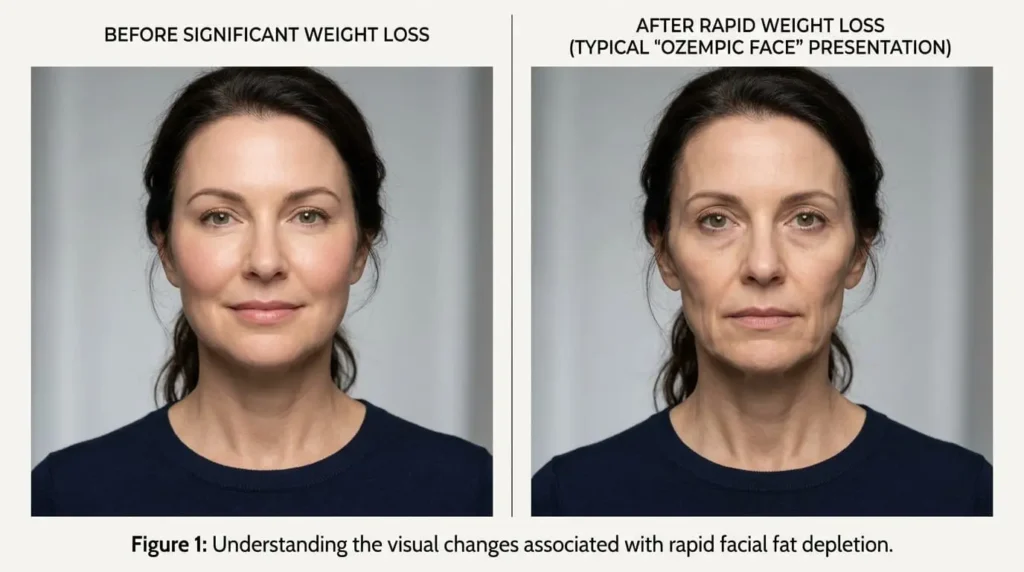
Have you recently achieved incredible weight loss results, only to look in the mirror and notice hollow cheeks, sagging jowls, or newly formed wrinkles? If so, take a deep breath you aren’t alone, and your hard-earned progress is still something to celebrate. This phenomenon is a common “gut-check” moment on the journey, but it’s one that we can navigate together with comfort and safety in mind.

As GLP-1 medications become the gold standard for treating obesity, aesthetic side effects are a reality we must address with transparency. While shedding significant weight is a massive win for your long-term health, your skin sometimes needs a little extra help to catch up. In this review, we will provide a reassuring guide on the ozempic face meaning, the best expert-led treatments, and how to prioritize your self-care during this transformation.
What is the true ozempic face meaning?
The term “Ozempic Face” was coined by dermatologists and plastic surgeons to describe a specific set of facial changes observed in patients taking semaglutide. The ozempic face meaning essentially boils down to rapid facial volume loss. When you lose a massive amount of weight quickly, the fat pads in your face which are responsible for keeping your skin looking plump, lifted, and youthful shrink dramatically.
It is crucial to understand that the medication itself does not directly attack facial collagen or skin cells. If you read our guide on how GLP-1s work for weight loss, you’ll know that the drug simply induces a massive caloric deficit. The resulting rapid weight loss face aging is a natural consequence of gravity pulling down on skin that has been suddenly emptied of its underlying fat support.
The core characteristics of the ozempic face meaning include sunken eyes, hollow temples, sagging skin along the jawline, and the sudden prominence of fine lines and wrinkles.
Review: top treatments for semaglutide face changes
Now that we understand the ozempic face meaning, let’s review the most effective cosmetic and dermatological solutions available in 2026 for treating semaglutide face changes. We have evaluated the top professional approaches.
1. Hyaluronic acid dermal fillers (Juvederm/Restylane)
Presentation: Injectable gels used to restore lost volume in the cheeks, temples, and under-eye hollows.
Features: Instantly plumps the skin, stimulating hydration. Can be customized by a skilled injector to rebuild the exact fat pads lost during weight loss.
Pros: Immediate results, non-surgical, minimal downtime, reversible if you are unhappy with the outcome.
Cons: Temporary (lasts 9 to 18 months), requires ongoing maintenance, can be expensive.
Price: $600 – $1,500 per syringe (most patients need 2-4 syringes).
Verdict: 9/10. The best immediate, non-invasive solution to combat semaglutide face changes.
2. Biostimulators (Sculptra/Radiesse)
Presentation: Injectable treatments that stimulate your body’s own natural collagen production over time.
Features: Unlike traditional fillers that just take up space, biostimulators trigger a mild inflammatory response that causes your skin to thicken and tighten itself organically.
Pros: Very natural-looking results, lasts up to 2 years, improves overall skin texture and elasticity.
Cons: Results take 6 to 12 weeks to appear; requires multiple sessions.
Price: $800 – $1,200 per vial (typically requires 2-3 sessions).
Verdict: 8.5/10. Ideal for patients looking for long-term structural improvement rather than a quick fix.
Ozempic face side effects & rapid weight loss face aging
When evaluating ozempic face side effects, it’s vital to separate myth from reality. The medication is not toxic to your skin. However, rapid weight loss face aging occurs because skin elasticity naturally decreases with age. If a 25-year-old loses 50 pounds quickly, their skin may snap back. If a 50-year-old does the same, the loss of elastin means the skin simply drapes loosely over the new, slimmer facial bones.
Common ozempic face side effects include:
- Deepening of nasolabial folds (smile lines)
- Loss of definition in the jawline (jowls)
- A skeletal or gaunt appearance in the mid-face
These aesthetic challenges should not deter you from the life-saving benefits of weight loss, but they are an important factor to plan for in your overall wellness journey.
How to prevent ozempic face effectively
The best treatment is always prevention, and we are here to guide you through it safely. So, how to prevent ozempic face without compromising your health? It starts with a gentle approach to weight loss.
Dermatologists agree on a proactive, empathetic strategy. First, prioritize a moderate rate of weight loss (1-2 pounds per week) to give your skin’s elasticity time to retract this is about your comfort, not just speed. Second, focus on high-quality protein to support your facial structure. Finally, think of your skincare as an act of self-love; medical-grade retinoids and daily SPF are your best friends in protecting the skin you’ve worked so hard to reveal.
The ozempic face meaning is simply the aesthetic result of highly successful, rapid weight loss not a dangerous chemical side effect of the drug itself.
- ✅ Ozempic face side effects are caused by the rapid depletion of facial fat pads and lack of skin elasticity.
- ✅ Dermal fillers and biostimulators like Sculptra are the highest-rated treatments to restore volume and structure.
- ✅ Learning how to prevent ozempic face through slower weight loss and protein intake is your best defense.
Don’t let the fear of facial changes stop you from achieving optimal health. Consult a board-certified dermatologist alongside your weight loss physician to create a holistic treatment plan.